
PERC introduced its Pandemic Misery Index, or PMI, in a blog post on September 8, 2020. Taking a cue from Arthur Okun’s misery index that added together the inflation rate and the unemployment rate, PERC’s PMI includes a measure of the public health impact of COVID-19 by using the total number of deaths per 10,000 of population, and adds that to the average unemployment rate - a measure of the economic impact - over the pandemic months starting in March of 2020.
Since it was first released, PERC has updated the state PMI values several times. Here, we discuss how states stack up based on cumulative death rates from March to December of 2020 paired with average unemployment rates for the same period.
The highest PMI value is assigned to New Jersey, the state with the highest cumulative COVID-19 death rate of 21.4 deaths per 10,000 people, and an average unemployment rate of 11%, resulting in a PMI of 32.44. New York is second, with a PMI of 30.65 based on 19.3 cumulative deaths for every 10,000 residents and an average unemployment rate of 11.3%. Massachusetts, Rhode Island, and Louisiana round out the top 5.
Looking at the four largest states, alongside New York’s PMI of 30.65, Florida has the second highest PMI, 18.78, based on an average unemployment rate of 8.7% and a death rate of 10.1. Texas is third, with a PMI of 18.24 based on 9.71 deaths per 10,000 residents and an average unemployment rate of 8.5%. California was slightly lower than Texas, with a PMI of 18.08. California has achieved the lowest death rate among the four largest states at 6.57, but the highest average unemployment rate at 11.5%.
The states with the lowest PMI values include Vermont, Utah, Maine, Alaska, and Oregon.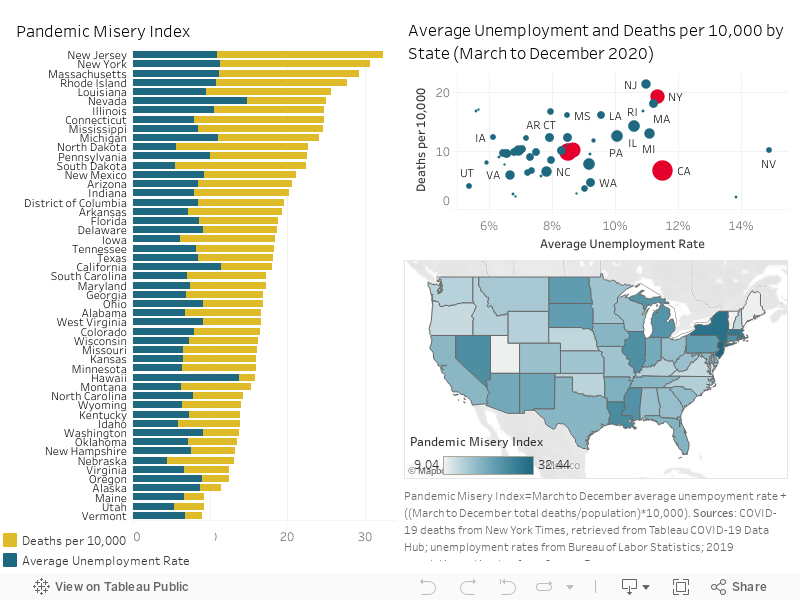
Other authors have written about blue state/red state policies in dealing with COVID-19, with blue states more focused on public health and using more stringent and lengthier restrictions on economic activities, while red states have been more focused on economic health and using less stringent and shorter restrictions on economic activities. Certainly, the big four states show this divide, comparing New York and California to Texas and Florida. Texas and Florida have much lower unemployment rates than either New York or California, and Texas and Florida have somewhat higher death rates than California. Of course, New York, whose numbers are affected by the high initial wave of cases and subsequent deaths, is an outlier on both dimensions, with a high death rate and a high unemployment rate. New York’s decisions and experiences were instructional to other states and the medical community is better able to handle cases today in part because of the events in New York.
The lowest death rates have been achieved by Vermont, Maine, Alaska, and Hawaii. The lowest unemployment rates have been achieved by Utah, Idaho, South Dakota, and North Dakota. The three lowest PMI values were captured by Vermont, Utah, and Maine.
Clearly, the PMIs for each state will continue to change as time passes, and state rankings will change as a result. Unemployment rates, while generally declining, are affected by each state's public policy and its industry mix, in addition to public health restrictions. Cumulative deaths are growing at different rates across states, and some states that had low death rates in the early months of the pandemic have seen rapid increases in these rates in the latter months included in this update of the index.
__________________________________________________________________________________________________________________________________________________
Data and Methods
We use coronavirus-related death information from the New York Times database retrieved from Tableau’s Covid-19 Data Hub. Population data come from the U.S. Census Bureau. Seasonally adjusted unemployment rates are sourced from the Bureau of Labor Statistics (BLS). The Pandemic Misery Index is calculated by adding the average unemployment rate from March to October, and the total number of deaths per 10,000 people for the same time period.
Since it was first released, PERC has updated the state PMI values several times. Here, we discuss how states stack up based on cumulative death rates from March to December of 2020 paired with average unemployment rates for the same period.
The highest PMI value is assigned to New Jersey, the state with the highest cumulative COVID-19 death rate of 21.4 deaths per 10,000 people, and an average unemployment rate of 11%, resulting in a PMI of 32.44. New York is second, with a PMI of 30.65 based on 19.3 cumulative deaths for every 10,000 residents and an average unemployment rate of 11.3%. Massachusetts, Rhode Island, and Louisiana round out the top 5.
Looking at the four largest states, alongside New York’s PMI of 30.65, Florida has the second highest PMI, 18.78, based on an average unemployment rate of 8.7% and a death rate of 10.1. Texas is third, with a PMI of 18.24 based on 9.71 deaths per 10,000 residents and an average unemployment rate of 8.5%. California was slightly lower than Texas, with a PMI of 18.08. California has achieved the lowest death rate among the four largest states at 6.57, but the highest average unemployment rate at 11.5%.
The states with the lowest PMI values include Vermont, Utah, Maine, Alaska, and Oregon.
Other authors have written about blue state/red state policies in dealing with COVID-19, with blue states more focused on public health and using more stringent and lengthier restrictions on economic activities, while red states have been more focused on economic health and using less stringent and shorter restrictions on economic activities. Certainly, the big four states show this divide, comparing New York and California to Texas and Florida. Texas and Florida have much lower unemployment rates than either New York or California, and Texas and Florida have somewhat higher death rates than California. Of course, New York, whose numbers are affected by the high initial wave of cases and subsequent deaths, is an outlier on both dimensions, with a high death rate and a high unemployment rate. New York’s decisions and experiences were instructional to other states and the medical community is better able to handle cases today in part because of the events in New York.
The lowest death rates have been achieved by Vermont, Maine, Alaska, and Hawaii. The lowest unemployment rates have been achieved by Utah, Idaho, South Dakota, and North Dakota. The three lowest PMI values were captured by Vermont, Utah, and Maine.
Clearly, the PMIs for each state will continue to change as time passes, and state rankings will change as a result. Unemployment rates, while generally declining, are affected by each state's public policy and its industry mix, in addition to public health restrictions. Cumulative deaths are growing at different rates across states, and some states that had low death rates in the early months of the pandemic have seen rapid increases in these rates in the latter months included in this update of the index.
__________________________________________________________________________________________________________________________________________________
Data and Methods
We use coronavirus-related death information from the New York Times database retrieved from Tableau’s Covid-19 Data Hub. Population data come from the U.S. Census Bureau. Seasonally adjusted unemployment rates are sourced from the Bureau of Labor Statistics (BLS). The Pandemic Misery Index is calculated by adding the average unemployment rate from March to October, and the total number of deaths per 10,000 people for the same time period.